
How the Munich Air Disaster Changed Manchester United on the Pitch
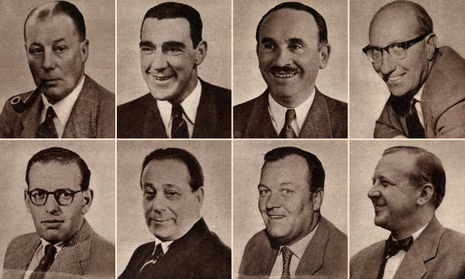
The Munich Air Disaster in February 1958 is rightly remembered as a human tragedy, but if you track Manchester United’s matches before and after the crash you also see a profound tactical break. The Busby Babes’ high-tempo, youthful attacking style was interrupted mid‑season, forcing the club to reconstruct not only a squad but an entire way of playing that had been years in the making.
Why the Busby Babes’ Style Mattered Before Munich
Under Matt Busby, United’s 1950s sides broke from the more conservative, result-first approach common in English football by playing a bold, front-foot 2-3-5 with an emphasis on youth and attacking flair. The Busby Babes pressed high for the era, pushed multiple players forward in waves, and relied on wide men like David Pegg plus central figures such as Tommy Taylor and Duncan Edwards to overwhelm opponents with numbers in the final third. When you watch surviving footage or listen to contemporary accounts, the repeated theme is movement and variety: full-backs overlapping, inside forwards dropping, and midfielders like Edwards driving from deep so that United rarely attacked with fewer than four or five players ahead of the ball.
How Munich Broke a Tactical Project in Its Prime
The crash at Munich-Riem Airport on 6 February 1958 killed 23 of the 44 people on board, including eight of United’s players and several key staff, and left Busby himself critically injured. Those losses removed not just individual talents but entire relationships—understandings between defenders, midfielders and forwards that had been refined over consecutive title-winning seasons in 1956 and 1957 as United chased further domestic and European dominance. For live viewers revisiting that season, the effect is that the fluidity and familiarity visible in games before the crash—such as high-scoring league wins and European ties featuring rapid combination play—suddenly disappears, replaced by a team patched together from survivors, reserves and emergency signings.
What United Looked Like on the Pitch Before the Disaster
In the 1957–58 campaign, United’s attack was built around a young core with an average age close to 23, combining energy with technical ability. Busby’s 2-3-5 encouraged wingers to hug the touchline and then cut inside, while inside-forwards and midfielders interchanged to create overloads, turning many games into stretched contests where United trusted their superior movement and finishing to outscore opponents. Matches such as the 7–2 win over Bolton, with Bobby Charlton and Dennis Viollet heavily involved, show how quickly they could turn pressure into goals, using long diagonal switches, quick one-twos, and surging runs from deep to create chance after chance.
How the Post-Munich Side Had to Adapt Its Playing Style
After Munich, caretaker arrangements and then Busby’s eventual return meant that United’s style went through a period of compromise: the squad no longer had the same depth of young attacking specialists, and emotional as well as physical recovery shaped performances. Surviving figures such as Charlton and Bill Foulkes were asked to carry heavier tactical and leadership loads, while emergency signings had to learn a high-risk attacking system in shortened timeframes and under intense scrutiny. In practical viewing terms, this often translated into slightly more cautious game management, less all-out commitment of numbers forward, and greater reliance on individual moments from key players rather than the relentless attacking waves that defined the pre‑Munich Babes.
How Busby Rebuilt Towards a New Attacking Peak
Busby eventually restructured his team around Charlton, Foulkes and new recruits including Denis Law and George Best, evolving towards a 4‑2‑4 and then 4‑3‑3 base that still prioritised attacking but with more modern balance between midfield and defence. By 1968, this rebuilt side won the European Cup with a 4–1 victory over Benfica, using quick wide attacks, intricate combination play and a flexible front line to dominate extra time. For viewers, that European success is both a footballing achievement and a tactical endpoint: it shows how Busby transformed grief into a new version of the same attacking philosophy, now expressed through Best’s dribbling, Law’s movement and Charlton’s long-range threat.
What to Watch For When Comparing Pre- and Post-Munich United
If you place pre‑1958 matches and 1960s games side by side, several visual differences and continuities become clear. Before Munich, look for the sheer number of players in advanced positions during attacks, with both full-backs and wing-halves willing to support in wide and central areas, creating a kind of controlled chaos that overwhelmed many domestic opponents. In the post‑rebuild European Cup side, the attacking commitment is still strong but more structured: wide players like Best hold width or drive inside from clearer starting zones, central midfielders balance forward runs with screening duties, and the back four maintains a more disciplined line than the old 2‑3‑5. Watching both eras helps you see Munich not as a complete break from attacking ideals but as a pivot from raw, youthful ambition to a more balanced, systematised version of the same club philosophy.
A Simple Table Framing United’s Tactical Evolution Around Munich
To keep the story clear while you watch, it helps to map United’s tactical identity across three phases: the Busby Babes before Munich, the immediate post‑disaster period, and the rebuilt European champions. The table below offers a concise snapshot of how style, structure and key figures shift across those eras.
| Phase | Approx. years | Base shape / emphasis | Key on-pitch characteristics |
| Busby Babes pre‑Munich | Early–mid 1950s–1958 | 2-3-5, youth-driven attacking | High numbers forward, wing play, fluid roles |
| Immediate post‑Munich | Late 1950s–early 1960s | Transition from 2-3-5 towards 4-2-4 | More cautious balance, reliance on survivors’ quality |
| Rebuilt European champions | Mid–late 1960s | 4-2-4 / 4-3-3 attacking structure | Best–Charlton–Law axis, quicker transitions, wide attacks |
Holding this framework in mind during a rewatch lets you interpret differences in tempo, risk-taking and spacing as part of a longer tactical arc rather than isolated coaching decisions. It also highlights how rare it is for a club to maintain a recognisable attacking identity through such disruption, and why Manchester United’s later European success is often described as both a footballing and symbolic response to Munich.
Summary
The Munich Air Disaster cut short a young, attacking Manchester United team built on a bold 2‑3‑5 and a philosophy of entertaining, front-foot เว็บดูบอล goaldaddy, removing key players who had already won back‑to‑back league titles and were pushing towards European dominance. In the years that followed, Busby’s reconstruction around Charlton, Foulkes and new signings produced a more balanced but still adventurous side that eventually won the European Cup in 1968, proving that the core attacking identity could survive tragedy and evolve into a new tactical form. When you watch matches from both eras, focusing on numbers committed forward, use of width and the roles of key players, you see how Munich reshaped not just a club’s history but the way its football has been played and understood ever since.